Showing posts with label Buenos Aires. Show all posts

Monday, June 4, 2012

Street Art in Boedo

My new obsession is Instagram. These are a couple of pics from the weekend, walking around the neighborhood of Boedo. Con el espíritu del Ñandú...


Friday, June 1, 2012

The White Rabbit

After the newspaper kiosk closes and the sun goes down, this little guy comes out to play on the corner of Dorrego and Amenabar in Palermo.

Monday, May 28, 2012

La Choza


My quest to find the perfect milk and yogurt in Buenos Aires is over; La Choza has it hands down. Thick, natural yogurt and delicious full cream milk, and when paired with some organic granola it makes my weekday breakfasts a breeze. 

I get my La Choza fix at El Galpon organic/hippie market in Chacarita, open Wednesdays and Saturdays.

Sunday, May 6, 2012

Colour and Chaos

Chaotic, old, dirty, colourful, vibrant... the city of Buenos Aires always has something to you show.

Wednesday, March 28, 2012

Casa Vieja


This old house in Palermo Hollywood caught my eye the other day, it has some great details if you look closely.

Tuesday, March 13, 2012

Casa Calise, Virginio Colombo

Virginio Colombo is another of Buenos Aires' Art Nouveau architects. Born in Milan in 1885, he came to Argentina when he was 21 and produced almost 50 buildings before his death in 1927 at the age of just 42. Two of his most iconic buildings are located in the neighborhood of Balvanera: The Casa de los Pavos Reales at Rivadavia 3216 and the Casa Calise at Hipolito Yrigoyen 2562, the latter depicted in these photos.

The Casa Calise is hidden in the backstreets, away from the tourist circuit. The facade features many decorative features such as cherubs, sculptures, lion heads, the use of different textures and ironwork, and has become one of the iconic examples of the Art Nouveau movement in Buenos Aires.

In order to build this new style of building that broke away from traditional architecture, Colombo purchased the land facing the Casa Calise so that nobody could object to his style. The building that now stands across the street was also built by Colombo and is quite different but incredibly beautiful. Such amazing history in the same narrow street!

 It is extremely difficult to photograph this building as the street is so narrow and there are trees that block the lower half!

Saturday, March 10, 2012

Bookstore, Avenida de Mayo

A couple of weeks ago on an excursion with my architecture class, we stumbled upon this bookstore located inside one of the Art Nouveau buildings we were all admiring. The owner invited us inside to look at the building and her shop, which turned out to be quite amazing for two reasons: the collection of vintage books and Argentine memorabilia and the building itself with an amazing ceiling and other architectural details.

The bookshop is called La Calesita and I am definitely planning a return visit in the near future.

Wednesday, March 7, 2012

More Art Nouveau


Some more Art Nouveau buildings by Julian Garcia Nuñez. Perhaps his most well-known building the Hospital Español (above) on Avenida Belgrano and La Rioja (only half of it remains today), and below, an office building at Chacabuco 78 in the heart of the city.


Monday, February 27, 2012

Art Nouveau in Buenos Aires

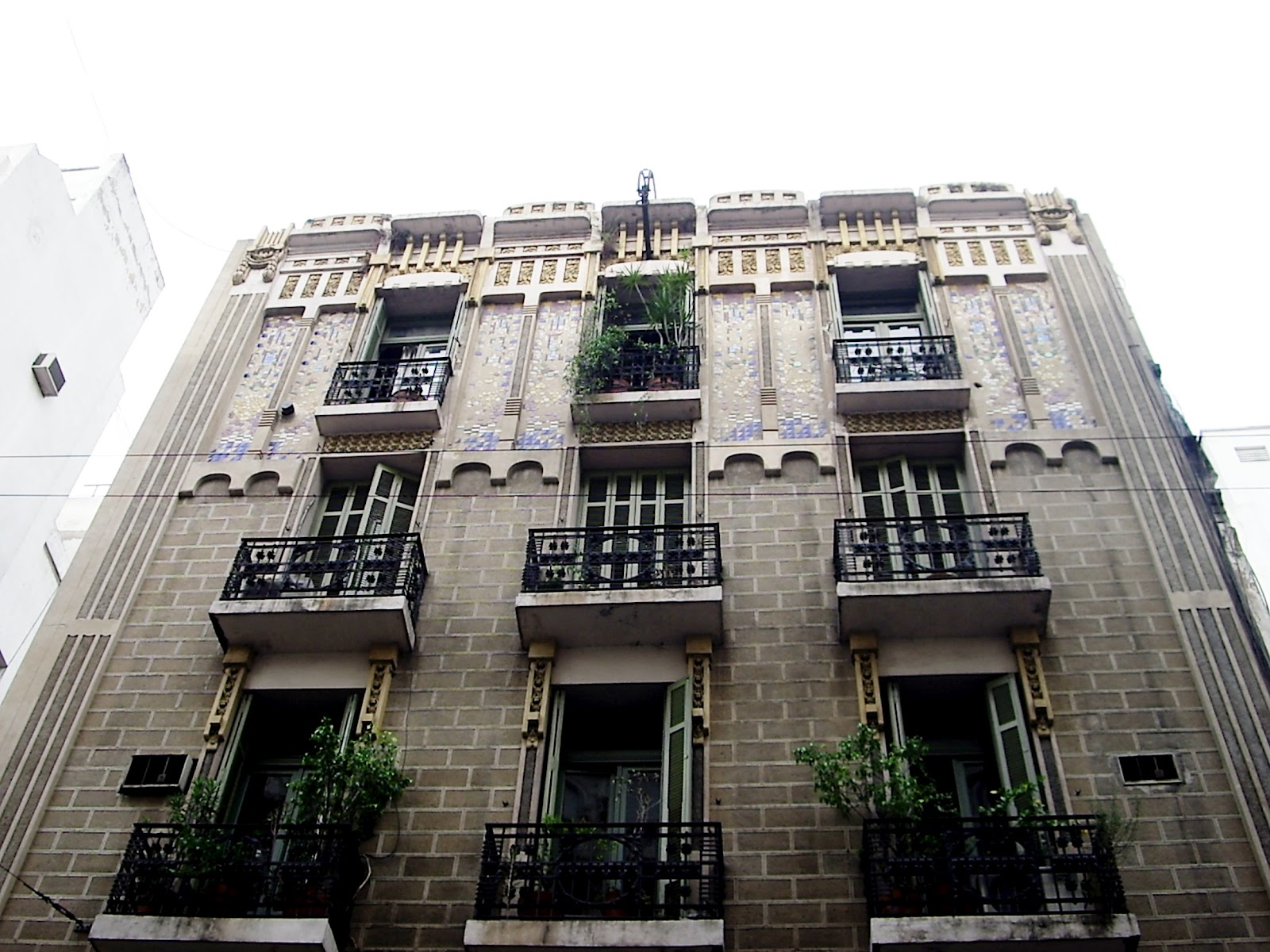
One of the most important Art Nouveau architects in Buenos Aires at the turn of the 20th Century was Julian Garcia Nuñez. His distintive architecture broke away from the traditional academic style and favored the use of different textures and colors, iron work, geometric forms, patterns and lines that reflect flowers and nature.

He built most of his work between 1906 and 1920 and while some of his buildings no longer stand, many can still be found around the place. Because Art Nouveau was a radical new style of architecture it was not adopted by the government, and the buildings were not constructed in the very centre of the city. As the city of Buenos Aires expanded and now approx. 100 years on, many Art Nouveau buildings are hidden in the back streets of different neighbourhoods.

This first building I have included was completed in 1913 by Garcia Nuñez as a Casa de Rentas or apartment building and stands in a back street at Sáenz Peña 274 near the Plaza de Congreso.
 This last photo shows the architect's signature "J Garcia Arq. 1913" which he used to mark all of his buildings in the early part of his career.

Friday, February 17, 2012

Street Artist Antis


I found the artist that did the street art on the building in my post below, her name is Antis. She has a lot more art around the place in Buenos Aires, check out more on her website here! I hope I run into some more of her work now that I know her aesthetic. (photos from the artist's website).

Tuesday, February 14, 2012

Casa in Palermo

Some super cute street art to make this otherwise slightly scary-looking building a bit sweeter...

Monday, February 13, 2012

Teatro Regio

I pass this theatre every morning on the bus heading to work, in the barrio of Colegiales. It looks like such a lovely old theatre, I would love to see inside. It was built by a wealthy businessman who lived in the neighbourhood and wanted to bring more culture to the area. Inaugurated in 1929, it was inspired by Spanish Baroque architecture. 

Saturday, February 11, 2012

Thirty Three Orientals

This street is near my apartment and when I see it I always wonder who came up with the name and why. In English it translates to thirty three oriental people...

UPDATE: thanks to a fellow Twitter-er who informed me of the reason behind the name!  As wikipedia tells me
"The Treinta y Tres Orientales (English: thirty-three orientals or thirty-three easterners) was a militant revolutionary group led by Juan Antonio Lavalleja against the Empire of Brazil. Their actions culminated in the foundation of modern Uruguay. They became famous by the name of the Treinta y Tres Orientales when, in 1825, they began an insurrection for the independence of Oriental Province, a historical territory encompassing modern Uruguay and part of modern Brazilian Rio Grande do Sul State, from Brazilian control."
What was life like before the internet and Wikipedia? I try to block it out.

Sunday, February 5, 2012

Grand Old Caballito

There are some amazing old houses in certain parts of Caballito, a suburb right in the middle of Buenos Aires. Two thirds of the suburb is full of tall apartment buildings built from about the 1960s/70s onwards, but a couple of areas remain with these old beauties. These are just a couple examples of the grand old architecture that I love.

This amazing old house below is unoccupied ; the windows are cemented over to avoid squatters living there. On closer inspection the house is about four stories tall with a roof-top terrace as well. It must be so old and incredible inside, I wonder if it is full of old furniture, and who owns it. Such a shame that it is just sitting there with no one to bring it back to life. My dream Buenos Aires house!


Friday, January 27, 2012

Chan Chan Peruvian Food

I have decided that Chan Chan is my new favourite restaurant because it ticks all the boxes; great food, great price, great atmosphere, casual, and the decor is uber-kitsch and fun. I honestly don't know how they keep their prices so low. Dinner for two last night cost 75 pesos and you are hard pressed these days to get dinner for 1 at that price. The place always has a healthy number of tourists gracing the tables too, which usually drives prices up.

It's this type of place that keeps me happy and stops me from losing faith in the ever-crazy world of inflation in Buenos Aires. Thank you Chan Chan!

Thursday, January 5, 2012

SUTERH - The Union for the Doormen of Buenos Aires

This building on the corner of Venezuela and Balcarce in San Telmo is a sports and leisure centre for the doormen of Buenos Aires and their families.  The porteros as they are called, have a union that was founded in 1942 by the government of Peron, who established many rights and unions for the working-class in Argentina. 

I always passed by this old building and thought it was a factory with those huge windows and high ceilings. Perhaps it was before being converted into the sports centre. Now when I pass by I imagine all the little porteros with their families being sporty and recreational.